
The Main Inbox: A place where it is quite difficult to make emails reach. That’s majorly due to “Email Deliverability Issues”!
Throughout our journey in email marketing, we’ve witnessed “out of the blue” cases. We’ve seen the most mindful and strategic emails getting marked as spam/junk.
Don’t fret! But yeah, it happened!
From offline business communication to email communication, everything has its own challenges and flaws. But we do have a fix for all.
You had an intense argument with your client, you think oh I can just be polite and sort, get a deal! To be precise, overcoming looks easy. But with “email deliverability issues”, people often presume it to be too technical, finding a solution appears challenging. Trust us, that’s just in the head. Reality, it’s the reverse, it is easy to tackle. All you need is a thoughtfully built plan.
Therefore, if your promotional email isn’t sent to the client inbox, we’re here to help you! Read our blog, get the solution, Tah-dah. A good deal!
Here in this blog, we’ll be covering “what are the major email deliverability issues?” along with the best solutions to overcome.
Get ready to land your email in the “Inbox”, don’t worry not spam but the “main”!
 Are you unaware of the reasons why your email deliverability rate is declining day by day. Let me tell you that’s a common battle for all marketers. More than 80% of marketers are struggling.
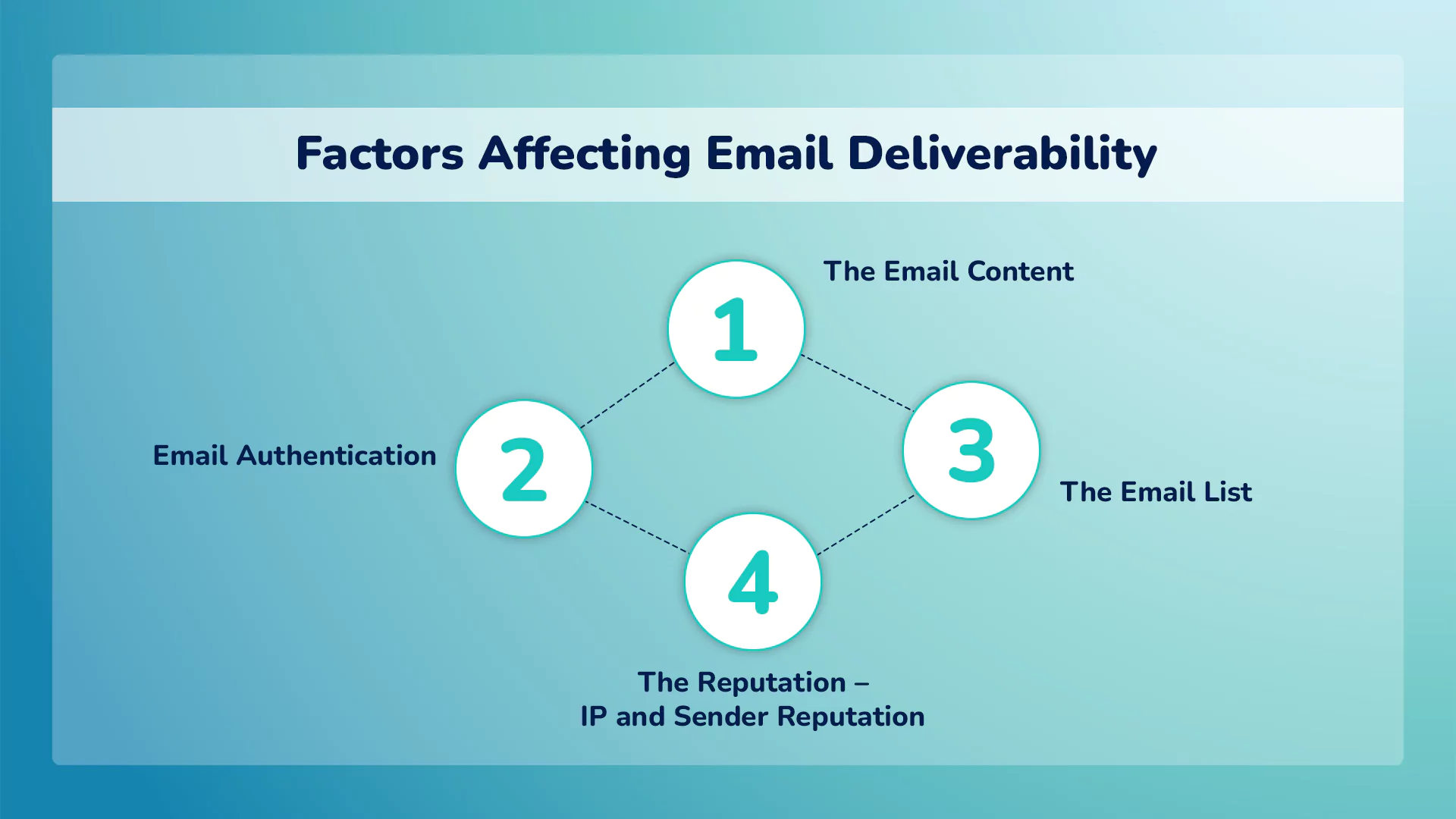
To put an end to your struggle, we’ve listed most important and common factors influencing the “email deliverability.”
Let’s briefly understand!
 If your email deliverability is low, you’ll be encountering various challenges, a few of them are as follows:
What is Email Deliverability?
Email Deliverability refers to the number of emails that reach the “primary inbox” without being sidetracked into the spam/promotional folder. A higher email deliverability rate means your email always hits the recipient’s main inbox. This clearly indicates increased probability of your prospects clicking and viewing your email, leading to better engagement. Good deliverability also means good connections with your “target audience.” Chances of securing deal are almost guaranteed. Email Campaigns generate $44 for every $1 spent but imagine your email didn’t get delivered in the recipient’s inbox, you clearly can’t get this return. All you get here is a loss of $1. Moving forward, have you ever come across the term “email delivery”. You might think it is same as “email deliverability” right? But it isn’t! Let me clarify this for you today! Often, email delivery and email deliverability are used interchangeably, although it shouldn’t. These are two different concepts. The former implies how many emails were delivered either in main, spam/junk, promotion folder, the latter tells the number of emails reached the “main inbox.” Whether it’s a budding or an established organization, if “email marketing” is a part of your marketing strategies, keeping a close eye on “email deliverability” is paramount for business success. A slight decline in the deliverability rate (the percentage of emails delivered) has detrimental impact on business reputation, image, and growth.What are the Factors Affecting Email Deliverability?
Are you unaware of the reasons why your email deliverability rate is declining day by day. Let me tell you that’s a common battle for all marketers. More than 80% of marketers are struggling.
To put an end to your struggle, we’ve listed most important and common factors influencing the “email deliverability.”
Let’s briefly understand!
1. The Email Content
Under email content, there are several things if goes south leads to low email deliverability. Such as subject lines, images, forms, content volume, too promotional words, and sometimes overuse of exclamation marks.Subject Lines
“Approx. 69% of the recipients considers email as spam due to subject lines.” A colossal figure to destroy the brand reputation. If subject line has promotional words, long sentences, irrelevant information, in such case, it is surely marked as “spam”, resulting in low email deliverability.Images
Overuse of images is never a good approach, it always appears to spammy, resulting in your email getting flagged as spam.Content Volume
Overstuffing your email content with fluffs and fillers is a complete wastage of time and effort. Result? Your email is seen sitting alone in the spam, no one cares about it. Also, writing words in upper case causes deliverability issue. Such as “PLEASE FIND THE LINK ATTACHED” looks only spammy, right? Indeed, it is! You might have observed few emails have full URL included of 3-4 lines that make the email look spamForms
Embedding forms/files to your emails is/was never a good move. The risk of your email being marked as “spam” exacerbate. Over and above that, the loading time also increases, which isn’t good. Nowadays, professionals are mostly swamped, not ready to wait. Output? Your email goes unnoticed.2. The Reputation – IP and Sender Reputation
Did you send an email, and it showed “undelivered.” This is due to low sender score. The Internet Service Providers assigns a score based on many factors. Such as bounce rate, spam rate, and unsubscribe rate. High bounce, spam, and unsubscribe rate led to low score by ISPs, meaning decreased email deliverability. Next is the utilization of “free domain email address” such as Gmail, Yahoo, Hotmail, etc., for sending emails in a bulk. It is clearly not a good idea. Result? “Spam” Why so? As under the revised DMARC policies, sending bulk/commercial email via free mail service providers leads to email spam. Instead choosing an official business email is preferred. This enhances the sender’s reputation, making your business look genuine and legit, ultimately sharp increase in KPIs.3. The Email List
Bad quality email list filled with erroneous, stale, irrelevant, and inaccurate recipient’s email address leads to your email ending up in spam, and of course unopened. Often purchasing email lists is a bad idea, it includes non-opt in contacts, meaning the individuals in the list have not willingly given their email ids. It’s just the email list provider scraped from some tools/websites and added. The users in the list aren’t aware of who you are, they have no idea if your business exists. This affects the email deliverability rate.4. Email Authentication
Not adhering to email authentication methods such as SPF, DKIM, and DMARC is clear sign of “fraudulent.” Thinking what actually SPF, DKIM, DMARC is about? Let me tell you! It helps to confirm sender’s identity and ensure email is not sent via malicious means. Even if your email is not authenticated with one of the above authentication processes, it is confirmed to get marked as “spam”, damaging the trust. Now you know what are the reasons behind “your email always getting flagged as spam”, let’s look at the challenges attached and the solutions to overcome.What are the Low Email Deliverability Challenges?
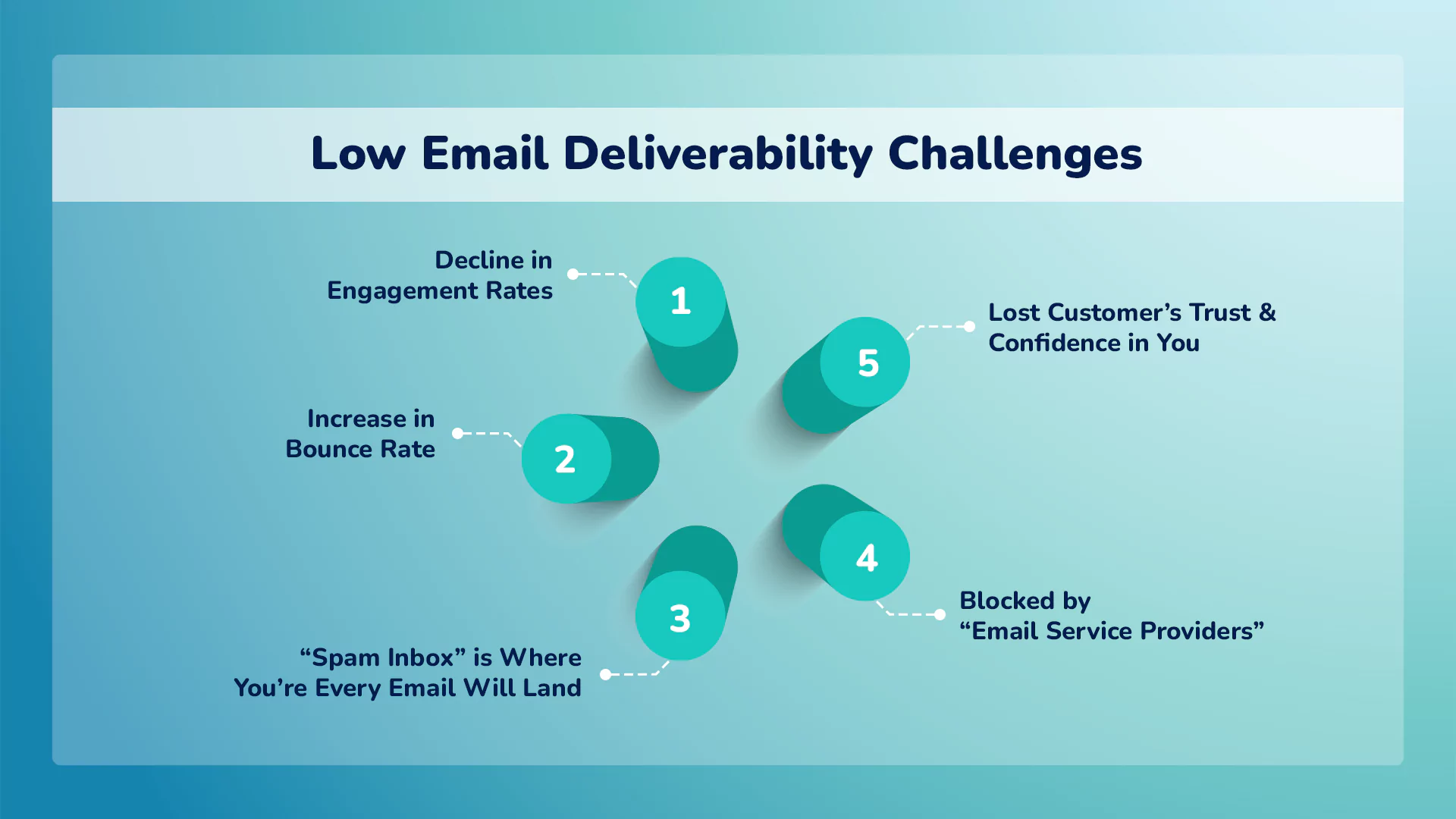
If your email deliverability is low, you’ll be encountering various challenges, a few of them are as follows:
1. Decline in Engagement Rates
Isn’t that obvious if your “email is landing in the spam”, the recipients aren’t clicking or viewing your email. Recent research states that only 3-4% of people check spam inboxes, indicating a drop in the probability of your email being checked.2. Increase in Bounce Rate
Deliverability rate has an indirect relationship with bounce rate. Lower the deliverability rate, higher is the bounce rate and vice versa. Higher bounce rate means your email hasn’t reached the recipients inbox.3. “Spam Inbox” is Where You’re Every Email Will Land
100% True. Low deliverability rate means there’s a complete chance of your email being seen in the spam folder. There is a waste of budget and human efforts leading to decline in the company’s overall revenue.4. Blocked by “Email Service Providers”
Low deliverability often leads to you being blocked by mailbox providers, meaning your email won’t even reach the inbox. This damages your reputation, further gaining trust becomes challenging. How does this happen? If your email deliverability is low, it automatically sends your email to spam, if this happens often, the ISP blocks sender’s domain.5. Lost Customer’s Trust & Confidence in You
If email deliverability is low, your email goes in spam, this makes your email appear like it has been sent via unverified means. The recipient might also think there’s no realness in your email content, leading to loss of customer trust. Without going into the specifics about your business, they’ll prejudice against your brand’s name and fame.What are the Best Practices for “Good Email Deliverability?”
This is not only the best practices, but also the solutions to the challenges faced with low email deliverability. If you’re finding solutions to email deliverability challenges in the USA or worldwide, start implementing the following practices from now and witness your email message landing straight into the “primary inbox.” 1. Curate your email content properly, avoid usage of “spammy/too promotional words. Make sure 60% of email contains text and 40% images. If you add links, make sure to “chip” and denote it with a name which defines what the link actually contains when we click. The subject line should be short, crisp, and to-the-point. For example, if you want to tell your customers about the upcoming sale (only on accessories), add in your subject line “Brand Name – Sale in 5 days – Only on Accessories.” This is an example of effective and perfectly curated subject line. 2. Proper email authentication is a must. Use authentic and reputable email address and domain. Adherence to SPF, DKIM, DMARC helps to improve delivery, protecting your reputation and building trust. Also, you’ll get higher scores from the ISPs. Also, you must choose reputable and legitimate Internet Service Providers for email communication. Don’t fall for shady ISPs offering email service at the cheapest price, and result, just scam. 3. Regularly cleansing of list will ensure you’ve list of users who are interested in your business communication, and ready to read your message. It’s better to grow your list of “high-quality leads” from scratch instead of purchasing. You can collect contact information through survey forms, sign-ups, social media, etc. This approach will help you get contacts of only those “professionals/businesses” who willingly gave their email for further communication. However, it eats up your time and efforts. A good alternative to it can be MedicProspects, a B2B healthcare data provider. If you’re looking for contact details from the healthcare industry, nothing is better than our email list. We strictly abide by clean data collection and global data regulation standards. We only add opt-in and verified contacts. A CEO of pharma company situated in the United States purchased the “Cardiologist Email List.” Look what he says – “I was also one among the person who grows email list ending up with only 5 good contacts, approximately 10 wasted days, and around 240 wasted hours. Later I came across this provider named MedicProspects. They offered accurate email list of cardiologists with the exact information I mentioned to them at a budget friendly amount.” “Get rid of invalid/inactive/dormant email addresses only with MedicProspects support.” 4. Send relevant, and hyper-personalized content. Avoid adding too much information in paragraphs in your email. If you’re using free domain email addresses such as GMAIL for mass communication, it’s advisable to stop now. If you own or working in a small-scale business utilizing free mailbox providers works to some content because you don’t often need to send bulk emails. Although, regardless of small, mid, or large-scale business, if you’re sending mass emails or relying on email communication on a daily basis, you must go for paid ISPs.Deliver Your Email into the Primary Inbox with MedicProspects!
Ensuring your email captures the recipient’s primary inbox is not a tough nut to crack. A well-thought approach, clean and best practices, and mindful move is all you need. Icing on the cake invest in MedicProspects B2B data and get the primary thing to send an email. An authentic, accurate, verified, and relevant contact details of target audience. Also, professionals in our list want to get promotional and valuable emails from you. “Contact details are the foundation of any email campaign.” With us, you’ll have well-built foundation, and slight adherence to best practices is required. Results? Better Engagement Increased Open rate and click-through rate More Reponses Increase in Number of Deals Closure High Deliverability Rate Increased Revenue and SalesConclusion
Remember the first line, “The Main Inbox: A place…………….”, isn’t true right now. With the above-insights and MedicProspects support, it is quite easy to ensure every email you send hits the recipient’s main inbox. Right? Certainly Yes! No more worrying about spam rates, bounce rates, compliant rate. It is not going to happen from now, if you diligently abide by the best and right practices. “Low email deliverability is no more a problem for you, all you have is “good email deliverability” to witness. All you need to do is read the above information profoundly and implement it strategically. If you’re a healthcare business seeking medical professionals contact information, contact MedicProspects for the best solutions. Email: info@medicprospects.com Call: +1 302-204-1434