
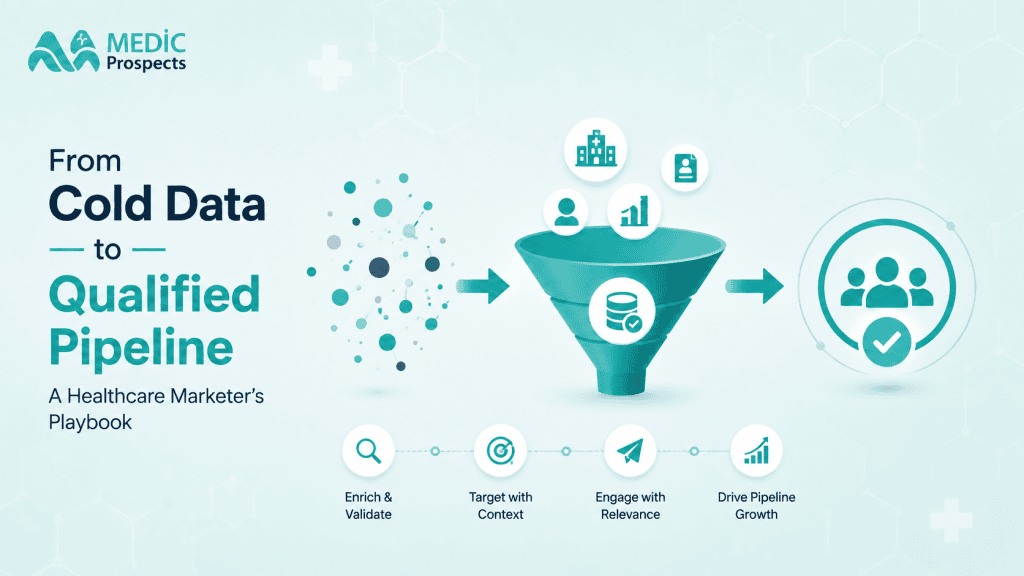
Healthcare marketers do not have a lead generation problem. They have a lead qualification problem.
Most healthcare GTM teams already sit on thousands — sometimes millions — of contacts: physicians, health system executives, procurement leaders, practice owners, revenue cycle teams, and digital health buyers. Yet pipeline targets still get missed. Raw data alone does not create buying intent, market timing, or trust.
Here is what makes the situation worse than most teams admit out loud.
According to Gartner, poor data quality costs the average enterprise $12.9 million annually — a figure that does not include the downstream damage of missed pipeline or wasted SDR time. And B2B contact data does not sit still. MarketingSherpa research puts the average decay rate at 2.1% per month, compounding to roughly 22.5% per year. In faster-moving sectors, that decay rate hit 3.6% in a single month in November 2024 — nearly double the historical baseline.
Healthcare amplifies this decay problem because the market is structurally fragmented in ways other industries are not.
A physician may hold admitting privileges at three hospitals while practicing at a private group. A digital health executive may influence buying decisions across a health system but operate from a personal email. A procurement stakeholder may have no public presence at all. A healthcare startup founder may simultaneously act as buyer, evaluator, and implementation lead.
This is exactly why the old motion of “buy list → blast campaign → expect demos” falls apart in healthcare faster than almost anywhere else. And it is what shaped how we built MedicProspects from the ground up. After supporting over 2,000 B2B teams through our parent brand DataInfoMetrix, the pattern was clear: the teams missing pipeline were not failing at outreach mechanics. They were working from data that was too generic, too stale, or too shallow to produce the kind of relevance that healthcare buyers respond to.
The teams generating consistent, qualified pipeline today are not simply buying better lists. They are turning cold healthcare data into market intelligence systems — and operating those systems continuously, not quarterly.
The Healthcare Buying Journey Has Already Changed
Healthcare marketers still model the buying journey like a funnel:
Awareness → Consideration → Demo → Opportunity → Closed Won.
That is not how modern healthcare buying actually works.
According to Forrester’s 2024 Buyers’ Journey Survey of 11,352 buyers worldwide, 92% of B2B buyers start their journey with at least one vendor already in mind, and 41% already have a single preferred vendor selected before formal evaluation even begins. Forrester’s own framing of this finding is direct: “B2B buying today is a process of confirmation, not selection.”
Gartner’s 2024 research reinforces this from a different angle. B2B buyers now spend only 17% of their total buying time in direct contact with potential vendors. The remaining 83% happens independently — through search, peer communities, analyst content, LinkedIn, and increasingly, AI-assisted research. By the time your SDR sends the first email, the real evaluation may already be two-thirds complete.
6sense’s 2025 Buyer Experience Report adds more weight here. In 85% of deals, buyers ultimately purchase from one of the vendors on their “Day One” shortlist. Earn a spot on that shortlist before intent signals become visible, or you are competing from behind.
Healthcare buyers behave this way too — often more cautiously. A hospital CIO evaluating AI documentation tools has likely already built a mental shortlist from peer conversations at conferences, LinkedIn content, and system-specific user forums. A VP of Revenue Cycle researching automation vendors may have spent weeks reviewing implementation stories from comparable organizations before your name ever enters their inbox.
The implication for healthcare marketing is significant. Marketing is no longer just responsible for generating awareness. It is responsible for shaping market preference before intent becomes detectable.
Cold Data Has No Value Without Context
Most healthcare databases stop at identity-level information:
- Name
- Title
- Organization
- Phone number
That is not pipeline intelligence. That is a contact list.
Real pipeline intelligence answers different questions:
- Is this organization actively investing in transformation right now?
- Has this executive changed roles in the past 90 days?
- Is this hospital system expanding locations or facing financial distress?
- Has the health system recently secured funding or completed an acquisition?
- Is the practice mid-way through an EHR transition?
- Has the organization publicly announced AI, interoperability, or operational initiatives?
- Does this physician influence purchasing decisions or only clinical adoption?
The difference between cold data and qualified pipeline comes down to one word: context.
This is where many healthcare marketing teams underinvest. A database of 50,000 healthcare contacts sounds impressive internally. But a segmented, context-enriched database of 5,000 healthcare buyers with verified organizational signals will almost always outperform it in pipeline contribution.
Role-based targeting without organizational context is especially dangerous in healthcare. A Chief Medical Officer at a 40-bed rural hospital does not buy like a CMO inside a 20-hospital integrated delivery network. A Director of Digital Transformation inside an academic medical center behaves completely differently from one inside a private specialty group. Without that organizational layer, campaigns default to generic — and generic messaging gets archived before it gets read.
This is the distinction that MedicProspects was built around. Instead of packaging broad contact files by job title category, every list we build starts with a targeting conversation: which roles actually hold purchasing influence in your specific deal, what facility types and specialties match your ICP, and what organizational signals separate a timely prospect from one that is three years away from a relevant decision. The output is a custom-built database, not a pre-packaged export that five other vendors sold last week.
Why Healthcare Email Outreach Fails Before It Starts
Most healthcare outreach fails long before the email gets opened — and not because healthcare buyers hate cold outreach. It fails because the messaging signals irrelevance within two seconds.
Healthcare inboxes are overloaded with:
- Generic AI automation pitches
- Broad “improve patient outcomes” claims with no operational grounding
- Vague efficiency messaging that could apply to any industry
- Sequences that are clearly copied from a LinkedIn template
- Mass-blasted nurture campaigns that reference nothing specific
G2’s 2024 Buyer Behavior Report found that product review websites are now the most-consulted information source for B2B buyers, cited by 31% — up from just 13% in 2021. Buyers have trained themselves to find peer validation before engaging with any vendor. By the time your sequence reaches their inbox, they have likely already formed an opinion from sources your marketing team never touched.
Healthcare amplifies this dynamic because professional trust matters more in this industry than most. A physician executive is not going to respond to a message that sounds automated. A healthcare operations leader expects any vendor reaching out to already understand workflows, reimbursement pressure, staffing shortages, compliance complexity, and implementation timelines.
The highest-performing healthcare campaigns share four characteristics.
1. Narrow Segmentation
Instead of: “Healthcare IT Leaders”
Winning campaigns target:
- Epic-integrated community hospitals scaling ambulatory operations
- Ambulatory surgery centers building out their own RCM functions
- Behavioral health organizations navigating hybrid telehealth models
- Multi-location dental groups with fragmented billing infrastructure
- Value-based care organizations under downside risk arrangements
- Digital health companies transitioning from pilot sales into enterprise sales motions
Specificity increases relevance. Relevance increases the probability of a real reply — not a politely worded “not right now.”
This is also why we do not sell prepackaged lists at MedicProspects. Healthcare roles, specialties, and facilities vary too much for a pre-built file to stay relevant across different selling motions. A cardiovascular device company targeting cath lab directors at independent hospitals has almost nothing in common with a revenue cycle software vendor targeting CFOs inside multi-state health systems — even though both could technically be described as “healthcare sales.”
2. Timing Signals
A mediocre message at the right moment will outperform a polished sequence sent at the wrong one.
Healthcare marketers building real pipeline increasingly organize campaigns around observable triggers:
- New funding announcements
- Executive hires, particularly at the CIO, CMO, CFO, and VP level
- Hospital mergers and acquisitions — there were 72 announced transactions in 2024 alone, up from 65 in 2023, with more than 30% involving a financially distressed party
- EHR transitions or major integration projects
- CMS reimbursement policy changes
- AI adoption initiatives announced in press releases or job postings
- Interoperability mandate timelines
When an organization is mid-transition on any of these, buying windows open. Miss the window and you are back to cold.
3. Operational Language
Healthcare buyers respond to operational specificity, not marketing language.
Compare:
Weak: “Transform patient engagement with AI-driven workflows.”
Strong: “Reducing prior authorization turnaround time for multi-specialty groups running on Epic.”
The second message works because it demonstrates actual understanding of the operational problem. That specificity signals that the vendor has done real work in the market. It is also the kind of message you can only write when your targeting is narrow enough that you actually know what your prospect’s day looks like.
4. Buying Committee Awareness
Healthcare purchases rarely involve a single stakeholder. Forrester’s State of Business Buying 2024 report found that the average B2B purchase now involves 13 stakeholders, with nearly 89% of buying decisions crossing multiple departments. Gartner’s 2025 research puts healthcare enterprise deals at between 5 and 16 people, depending on deal size and scope.
Healthcare deals often exceed these averages. A hospital EHR integration may require sign-off from Clinical, IT, Security, Procurement, Revenue Cycle, Compliance, Finance, and Operations — all with different priorities and different thresholds for perceived risk.
If your outreach targets only one persona, pipeline velocity slows dramatically. Multi-threaded outreach mapped to the actual buying committee is how deals move. That means your contact data needs to go beyond one decision-maker title and reach every function that has a seat at the table — which is something we specifically build for when designing a list with a client.
Healthcare Data Decay Is a Revenue Problem, Not a Database Problem
Healthcare organizational structures change constantly — and faster than most marketing teams track.
Executives move between systems. Physicians join or leave group practices. Hospitals merge. Practice ownership shifts. Departments restructure after acquisitions. Digital health startups pivot their business models mid-year.
This creates a compounding problem in any static database.
B2B contact data decays at an average of 2.1% per month, reaching roughly 22.5% annually under normal conditions. But recent data shows that number is accelerating. RevenueBase tracked a 3.6% monthly decay rate in November 2024 — nearly double the traditional benchmark — driven by increased workforce mobility and post-pandemic job market dynamics.
Field-level research puts the realistic range for B2B contact data decay at 22.5% to 70.3% annually, depending on the sector and the number of data fields tracked — with job titles, direct phone numbers, and work emails showing the steepest drop-off rates.
What this means in practice: a healthcare contact database that was accurate when you purchased it is already meaningfully degraded within six months, and significantly unreliable within twelve — even if no one on your team has done anything wrong.
The strategic error most healthcare marketing teams make is optimizing for database growth instead of database health. A CRM showing 200,000 contacts sounds like a resource. A CRM showing 200,000 contacts of which 40,000 are outdated is a liability — specifically because it creates a false sense of pipeline coverage that only reveals itself after a bad quarter.
This is precisely why MedicProspects re-verifies our healthcare contacts on a monthly basis. Not because it is a nice feature to mention, but because a contact file delivered without continuous verification starts degrading the moment it leaves our system. Our 95%+ deliverability standard exists to protect the campaign investment you are about to make — not just to make the data look clean at the point of delivery.
The highest-performing healthcare GTM teams operate their data function more like a newsroom than a spreadsheet:
- Monitoring executive hires and departures
- Tracking organizational changes from SEC filings, press releases, and job boards
- Watching funding rounds and M&A announcements
- Following policy and reimbursement updates from CMS
- Refreshing physician affiliation data on a rolling basis
- Updating technology adoption signals from public sources
Data quality is no longer a backend operations issue. It is directly tied to how much of your outreach budget produces a reply, and how much of it disappears into outdated inboxes.
The Best Healthcare Marketers Think Like Researchers, Not Campaign Managers
The strongest healthcare marketing teams today do not primarily think of themselves as campaign operators. They behave more like industry analysts.
And that shift is not cosmetic — it is driven by buyer behavior.
Gartner’s 2024 data confirms that B2B buyers spend 80% of their buying journey in self-directed research. A 2023 TrustRadius study found that 87% of B2B buyers prefer to research product information independently before speaking to a sales representative. And G2’s 2024 Buyer Behavior Report shows that peer review sites are now the most-consulted source in the research process — ahead of analyst reports, vendor websites, and social media.
Reddit’s “Hidden B2B Journey” report, produced in partnership with SurveyMonkey and based on a survey of 1,200 U.S. business decision-makers, found that buyers are actively forming vendor preferences through peer communities and independent forums long before any vendor ever learns they exist.
Healthcare buyers do exactly this. Before anyone from your team knows a deal is forming, buyers are:
- Asking peers at other health systems about implementation experiences
- Validating vendor credibility through informal networks, conference hallways, and LinkedIn DMs
- Comparing documented outcomes from peer organizations
- Searching for failed deployments and implementation war stories
- Evaluating interoperability realities from practitioners, not from vendor datasheets
- Checking references before anyone is asked for references
This means surface-level content — blog posts that explain what a category is, or whitepapers that describe the vendor’s own product — does almost nothing to build pipeline in healthcare. It gets ignored because it does not reduce decision risk, which is the primary concern of any healthcare buyer spending organizational capital.
The content that actually generates qualified healthcare pipeline tends to be:
- Benchmark reports that let buyers compare their organization against peers
- Specialty-specific operational analysis tied to specific workflows
- ROI breakdowns with documented methodology, not marketing estimates
- Real implementation lessons, including what went wrong
- Workflow comparisons across different EHR environments
- Procurement checklists for evaluating vendors in a specific category
- Compliance impact analysis tied to specific regulatory changes
- Executive interviews from actual customers, not vendor-written case studies
Healthcare buyers reward expertise that makes decisions easier and reduces risk. They punish content that wastes their time.
Pipeline Generation Is an Orchestration Problem
Most healthcare GTM teams still operate their pipeline systems in silos:
- Data vendors
- CRM operations
- SDR outreach
- Content marketing
- Intent data providers
- Sales enablement
These systems were built separately, run separately, and are measured separately. The result is that information rarely transfers across them in time to matter.
Qualified healthcare pipeline emerges when these systems are working together continuously.
A strong healthcare GTM stack operates in layers that talk to each other:
Data Layer — Clean, verified healthcare contacts enriched with real organizational intelligence: funding status, technology stack, executive changes, expansion activity. This is the layer MedicProspects operates in — and it has to be correct before anything downstream can function.
Intent Layer — Signals that indicate timing, urgency, or active evaluation. Not just generic web traffic, but specific organizational behaviors that suggest a buying window is open.
Content Layer — Market education tied directly to the operational pain points your buyers are experiencing right now, not a library of evergreen assets no one reads.
Outreach Layer — Highly segmented, relevance-driven communication that reflects the organizational context your data layer has captured.
Sales Layer — Context-aware follow-up that gives the sales team actual organizational background, not just a name, title, and a LinkedIn URL.
The companies winning healthcare pipeline right now are synchronizing these layers continuously. Not at the start of a quarter. Not when a campaign is planned. Continuously — because healthcare market dynamics do not pause between your planning cycles.
One thing we hear often from teams that come to MedicProspects after working with generic data vendors is that the data problem was invisible until it was not. Campaigns looked active. Emails were going out. But the underlying list had not been validated for the specific ICP they were actually chasing — and no one had caught it because the volume numbers looked fine. Data layer failures are quiet. They show up in conversion rates, not send rates.
AI Will Raise the Stakes for Data Quality, Not Lower Them
A common assumption in healthcare marketing circles is that AI will fix poor targeting by making outreach smarter. That assumption is backwards.
AI amplifies input quality. If your underlying healthcare data is weak, outdated, or context-poor, AI-generated outreach simply scales irrelevance faster, at higher volume, with better grammar.
Gartner’s 2025 research found that 74% of B2B buying teams experience unhealthy internal conflict during the purchase process. Buyers are already under pressure to make the right call. Generic outreach — even when AI-generated — reads as irrelevant immediately, and irrelevance now carries a permanent cost: Gartner also found that 73% of B2B buyers actively avoid vendors that send irrelevant communications.
6sense’s 2025 Buyer Experience Report found that 94% of buyers are now using LLMs during their buying process — specifically to analyze sentiment in customer reviews and synthesize vendor comparisons before they ever engage directly. They are using AI to filter vendors before you know they exist.
The healthcare marketers who benefit most from AI will not be those generating the most content. They will be the ones feeding AI systems with:
- Better segmentation built from verified healthcare data
- Better account intelligence that reflects current organizational context
- Better timing signals tied to observable healthcare market events
- Better buyer understanding built from actual operational knowledge of healthcare workflows
AI becomes powerful when it is paired with strong market intelligence infrastructure. Without that infrastructure, it is just a faster way to send emails that do not get replies. That is the lens behind how we approach data advisory at MedicProspects — not handing off a file and wishing you luck, but working through the targeting logic with you so the list entering your AI-assisted outreach engine is actually worth amplifying.
What Qualified Pipeline Actually Looks Like in Healthcare
Qualified healthcare pipeline is not a bigger number of leads in the CRM. It looks like:
- Higher reply quality from the first outreach touchpoint
- Faster sales cycles because buyers are pre-educated before the first call
- Stronger meeting-to-opportunity conversion rates
- Multi-threaded stakeholder engagement rather than single-threaded sequences
- Better deal velocity because fewer people are being surprised mid-evaluation
- Lower customer acquisition cost as a percentage of deal size
- More inbound references from customers who were properly targeted and served
- Higher shortlist inclusion before RFPs are formally issued
And most importantly: sales teams trust the leads.
That last point matters more than most dashboards capture. Once an SDR or AE team loses confidence that marketing-generated healthcare leads represent real buying interest, the entire alignment between marketing and sales deteriorates quickly. Leads stop getting followed up with the same energy. The attribution data starts looking fine while pipeline quietly weakens.
The strongest healthcare marketing organizations treat pipeline credibility as a core operating metric — not just a relationship goal. They prioritize:
- Accuracy over scale
- Relevance over automation
- Timing over volume
- Operational insight over marketing language
- Context over templated personalization
That is how cold healthcare data becomes qualified pipeline. Not by buying a larger database. By building a deeper understanding of the market — and maintaining that understanding continuously enough to be relevant before the buying process formally begins.
Closing Thought
Healthcare marketing is at an inflection point. The old model rewarded access to large contact databases. The model that is replacing it rewards intelligence layered on top of those contacts.
Because buyers have already changed. Research behavior has changed. Trust formation has changed. Vendor evaluation has changed.
Forrester’s most direct summary of where we are now: “B2B buying today is a process of confirmation, not selection.”
That means the healthcare organizations generating durable pipeline are the ones who have already earned consideration before a buyer ever signals intent — not the ones with the most contacts, the fastest outreach sequences, or the most polished campaign templates.
At MedicProspects, the work we do sits at the start of that chain. Verified contacts. Custom-built segmentation. Targeting built around actual healthcare hierarchies, not job title keywords. Human advisors who stay in the conversation until your list is actually ready to activate — not just ready to download.
That is not a positioning statement. It is what the data problem in healthcare actually requires.