
Fifteen years ago, healthcare prospecting looked very different.
I still remember this one time I was sitting beside a hospital administrator during one of the interviews I was conducting. I was trying to understand how healthcare leaders evaluate vendors and solutions.
I could see him figuring out the medical vendors, and mostly I saw him just putting those emails in the bin.
I asked him a simple question:
“What makes you ignore a sales email?”
He smiled and replied, “When it’s obvious they don’t understand healthcare.”
That answer stayed with me.
After that, many times I’ve interviewed physicians, hospital executives, healthcare IT leaders, and healthcare marketers, and one thing that I found in common was : they all had a frustration that most outreach felt generic and repetitive.
The problem wasn’t a lack of information.
The problem was a lack of understanding.
And that’s exactly why Artificial Intelligence is transforming healthcare prospecting today.
Not because AI can send more emails.
Not because AI can automate more tasks.
But AI can finally help organizations understand who they should be talking to and why.
The Old Way: Much Data, Less Intelligence
For years, lead generation was largely just a volume game.
Companies purchased massive databases containing millions of contacts. The bigger the database, the better it seemed.
But healthcare? It works otherwise.
Healthcare is one of the finest industries in the world, it majorly works on specialised streams.
A medical device company selling orthopedic solutions has a completely different set of prospects than a healthcare staffing provider.
A pharmaceutical company targets different decision-makers than a healthcare technology vendor.
Yet many prospecting platforms treated healthcare as just another industry category.
Talking about the outcome, sales teams often found themselves sorting through thousands of useless contacts before finding the right audience.
The process was difficult, expensive, and frustrating.
What AI Changed
The biggest fear and misconception about AI is that it’s replacing human decision-making.
In reality, the most effective AI acts as an intelligence layer.
Instead of asking:
“Who can we contact?”
Companies can now ask:
“Who should we contact?”
That is a massive difference.
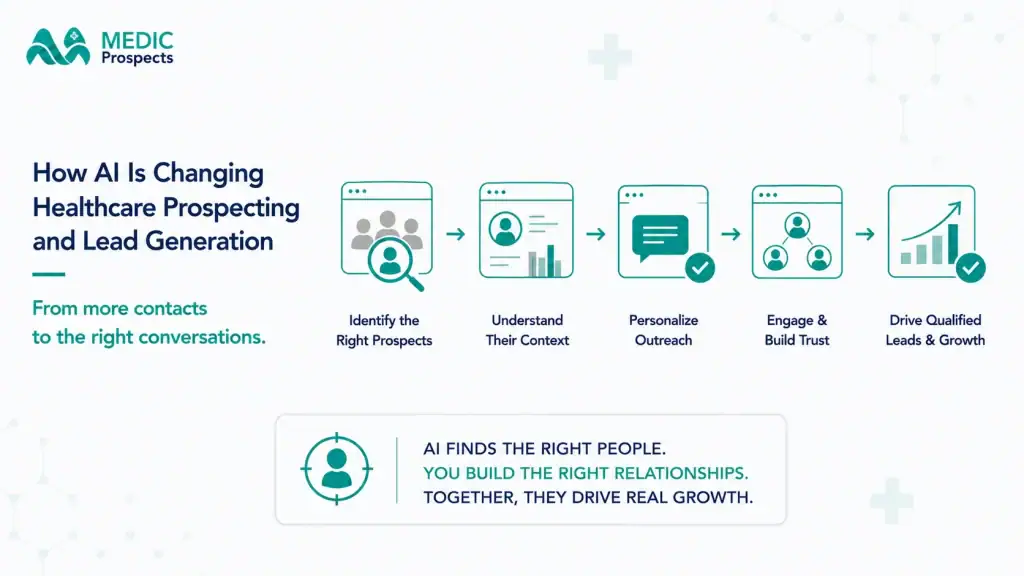
Modern AI systems can analyze organizational structures, specialties, job functions, purchasing behaviors, healthcare segments, and market signals to identify prospects that align with a company’s Ideal Customer Profile (ICP).
Rather than creating larger prospect lists, AI helps create smarter ones.
And in healthcare, precision matters more than volume.
Why Healthcare Requires Specialized AI
One observation I’ve made after years of interviewing healthcare professionals is that healthcare buyers expect relevance.
They don’t want broad industry assumptions.
They want specificity.
This is where many general prospecting platforms struggle.
Their databases are open across multiple industries and user groups. The same records may be accessed by countless organizations, including competing vendors targeting the exact same healthcare audience.
In many cases, everyone is working from the same pool of contacts.
As a result, healthcare decision-makers receive repetitive outreach from multiple vendors using nearly identical data.
This is why,
Response rates decline.
Trust decreases.
And valuable opportunities are missed.
At MedicProspects, we’ve taken a different approach.
Because we focus exclusively on healthcare, our target is positioned around healthcare-specific buyer personas, healthcare organizational structures, and healthcare market dynamics.
Instead of applying a generic AI model across every industry, we curate our website around a client’s Ideal Customer Profile.
Our objective isn’t simply to provide contacts.
Our objective is to identify the right healthcare professionals, in the right organizations, at the right stage of engagement.
AI Is Making Prospecting More Human
Surprisingly, AI is making healthcare prospecting more relevant.
I recently had a word with a healthcare leader who told me:
“For the first time, our sales team spends more time talking to prospects than searching for them.”
That statement perfectly captures the transaction that we needed.
Before, the prospecting process required continuous research, list cleaning, contact verification, and segmentation.
AI now handles much of that hard work.
As a result, sales professionals can focus on what they do best: building relationships.
And in healthcare, relationships still matter for decisions.
Technology may identify opportunities.
But trust closes deals.
The Future Isn’t Bigger Databases
I’ve learned throughout my career that healthcare organizations rarely choose partners based on who has the biggest database.
They choose partners who understand their challenges.
The future of healthcare lead generation isn’t about getting more records.
It’s about creating more relevance.
AI is helping organizations move away from mass prospecting and toward intelligent prospecting.
Instead of just reaching thousands of random contacts, companies can engage the healthcare professionals who are most likely to benefit from their solutions.
That creates better experiences for both buyers and sellers.
Final Thoughts
After these many years in healthcare marketing, I can surely note the changes in the way organizations identify and engage prospects.
I’ve seen the rise of digital marketing, social media, automation platforms, intent data, and predictive analytics.
But AI feels different.
Because for the first time, technology is helping organizations understand healthcare audiences at a deeper level.
And that’s exactly where AI is taking us.
Not toward more prospecting.
Toward smarter prospecting.
Conclusion: Understanding Will Always Win
When I think back about that hospital administrator, I realize his answer was never really about emails.
It was about relevance.
Healthcare specialists don’t want to be treated as just names in a database.
For years, prospecting focused on finding just more and more people to contact.
Today, AI is helping us focus on finding the right people to contact.
That’s a much-needed shift.
The organizations that will succeed in the future won’t be the ones with the largest databases or the most automated workflows. They’ll be the ones that combine AI with a genuine understanding of their audience.
At MedicProspects, that’s the vision we’ve always believed in. AI won’t be replacing human relationships in healthcare; it’ll help create better ones by ensuring every conversation starts with relevance, context, and understanding.
After fifteen years in healthcare marketing, one thing remains true: people do business with people who understand them.
AI is simply helping us get there faster.
And in a healthcare industry built on trust, that may be the most important advancement of all